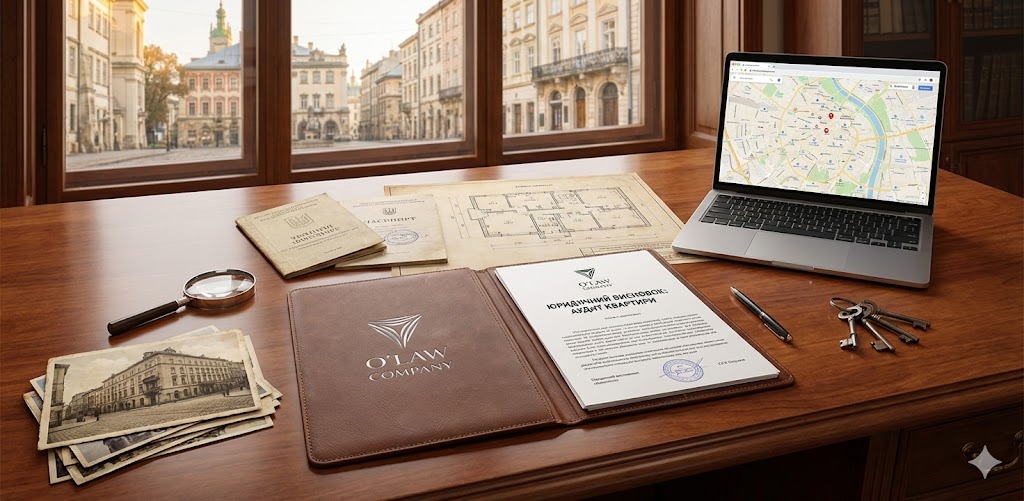
Buy safely: deep legal audit before signing the contract
Object history
Seller verification
Arrests & mortgages
Registered persons
Written opinion
Buying housing on the secondary market in Lviv is always a risk. A cozy apartment in an Austrian-era building on Lychakiv, a «Czech» panel on Sykhiv, or a cottage in Bryukhovychi can have such a legal history that it becomes the cause of litigation in 3-5 years. Realtors and sellers often rush to close the deal, concealing problems: hidden co-owners, debts to banks, registered relatives, contested previous transactions.
O'LAW attorneys conduct not a superficial but a deep legal verification of the property. We look not only at the «current moment» but retrospectively — at the chain of ownership transfers over 10+ years, at the seller's history, at risks that only a trained lawyer will see. The result is a written opinion with a clear recommendation: buy, negotiate reservations, or refuse. Information is current as of 2026.
7 risks hidden by «secondary market»
- «Sudden» heirs. Relatives appearing 3 years after purchase with a lawsuit to invalidate the transaction and claim their share
- Hidden co-owners. Seller's spouse from whom consent was not obtained (Art. 65 of Family Code) — transaction can be contested within a year of awareness
- «Permanent» residents. Registered minors, incapacitated, persons in prison or military service — impossible to unregister without special procedures
- Hidden encumbrances. Mortgage not removed from register, enforcement service arrest, tax lien — transfer «by inheritance» to new owner
- Fraudulent chain. Quick resales within 6-12 months hide the first illegal transaction — the entire chain is contested, your deal also suffers
- Unlegalized redevelopment. Removed load-bearing walls, combined rooms, balconies — fines from DIAM and impossibility of legal sale without bringing to compliance
- Fake seller. Forged power of attorney, sale on behalf of deceased or incapacitated person, passport fraud — not news plots but real cases in Lviv court practice
Which objects we verify
The verification algorithm is adapted to the type of real estate — for example, for land the focus is on designated use, for apartments — on registered persons, for houses — on technical documents and plot boundaries.
Apartments
Secondary market, Austrian-era, «Czech» panels, Soviet-era. We check ownership chain, registered persons, redevelopment, spousal consent.
Private houses and cottages
House + land = double check. Technical documents, plot boundaries, designated use, construction restrictions, change registration.
Land plots
Designated use (private farm, construction, gardening), restrictions, red lines, overlaps, easements, master plan, history of changes in State Geocadastre.
Commercial premises
Offices, warehouses, retail spaces. Special attention to designated use, lease agreements, OSBB relations, business activity permits.
Shares in real estate
1/2, 1/3, 1/4 in common ownership. Complex topic: preemptive right of other co-owners (Art. 362 Civil Code), use procedure, contestation risks.
Parking spaces
Separate real estate objects. We check title documents, designated use, boundaries, relations with OSBB or management company.
Legal framework
Property verification covers: Art. 182 of Civil Code of Ukraine (state registration of rights), Law «On State Registration of Real Property Rights and Their Encumbrances», Art. 215, 216 of Civil Code (invalidating transactions), Art. 65 of Family Code (spousal consent for disposing of joint property), Art. 17 of Law «On Childhood Protection» (protection of minors' rights during housing alienation), Art. 362 of Civil Code (preemptive right of share purchase in common ownership), Art. 376 of Civil Code (unauthorized construction — for unlegalized redevelopments).
Our verification algorithm: 6 areas
1
Object
Title documents (sale-purchase agreement, inheritance certificate, donation), technical passport, compliance of actual state with documents, presence of redevelopment.
2
Chain of ownership
Study of rights transfers over 10+ years through the State Register of Real Property Rights. Each previous transaction is analyzed for contestation risk — basis, parties, circumstances.
3
Seller
Verification in Unified Register of Court Decisions (bankruptcy, divorce, inheritance disputes), enforcement proceedings register, debtor registry, passport validity, signs of fraud.
4
Encumbrances
Arrests in State Register of Real Property Rights, mortgages, tax liens, alienation prohibitions, history of their imposition and removal. Identification of hidden encumbrances not in the register.
5
Registered persons
Full list of registered with focus on minors (guardianship authority permission required), incapacitated, persons in military service or prison — they cannot be unregistered without special procedure.
6
Family status and consents
Checking presence/absence of seller's spouse, need for consent (Art. 65 of Family Code), guardianship authority permission if minor owners involved, inheritance rights of others.
Registers we work with
-
1State Register of Real Property Rights (kap.minjust.gov.ua) — current owner, encumbrances, transfer history.
-
2Unified Register of Court Decisions (reyestr.court.gov.ua) — court cases against the seller and regarding the object (bankruptcies, divorces, inheritance disputes).
-
3Register of Enforcement Proceedings (asvp.minjust.gov.ua) — seller's debts that may become grounds for arrest.
-
4Unified Register of Debtors — travel bans, additional signs of financial problems.
-
5Bankruptcy Register (bankruptcy.minjust.gov.ua) — critically important: a bankrupt's property may be included in the liquidation mass.
-
6State Land Cadastre — for land plots: coordinates, designated use, restrictions.
-
7Movable Property Encumbrance Register — to identify claim rights that may relate to the seller.
-
8YouControl / Opendatabot — additional information about a legal entity seller: financial status, beneficiaries, related companies.
Why a notary is NOT a substitute for a lawyer
A common mistake: «The notary will check everything — why do I need a lawyer?» This is incorrect. Let's look at what each actually does:
- The notary checks: identity of parties, document validity AT THE MOMENT of the transaction, absence of current arrests in the register, certifies signatures. This is a LIMITED check «now».
- The lawyer checks: retrospective over 10+ years, risks of contesting previous transactions, seller's court history, hidden family circumstances, risks of unlegalized redevelopment, provides reasoned opinion with recommendations.
- The notary is NOT responsible for heirs appearing 3 years later with claims — that's not their area. The lawyer minimizes this risk as much as possible before signing.
Result — written opinion
You receive a structured document with register screenshots, document quotes, references to law. A clear conclusion: «safe to buy», «buy with reservations» (list of conditions to be obtained from the seller), or «not recommended» (with specific justifications).
Who especially needs verification
- Buyers of apartments in Lviv historical center — long ownership chains, inheritance risks, pre-war owners restitution rights
- Buyers through power of attorney — increased fraud risk, special check of power of attorney validity required
- Buyers with mortgage — the bank will do its own check, but it focuses on bank's risks, not buyer's
- Buyers of shares in common property — complex legal status, preemptive purchase right of other co-owners
- Buyers of property from elderly seller's relatives — additional risks: contestation through misrepresentation, incapacity
- Buyers of commercial real estate — verification of designated use, permits, OSBB/management company relations needed
- Buyers of land plots — separate complex area: designated use, restrictions, boundaries, easements
Frequently asked questions
Verify the property before signing
Written opinion with register screenshots, document quotes, references to law. Clear conclusion about purchase safety — in your hands within 1-3 business days.
Don't risk your home!
Saving on verification can cost you the apartment. O'LAW attorney will conduct deep audit and provide written opinion in 1-3 days.
- +38 063 404 67 68
- +38 068 679 52 51
- t.me/olaw_help
- o3law.company@gmail.com
- 32 Doroshenka St., Lviv
- Mon-Fri 10:00-19:00, Sat 10:00-14:00